The audience was an estimate. Now it is a count.
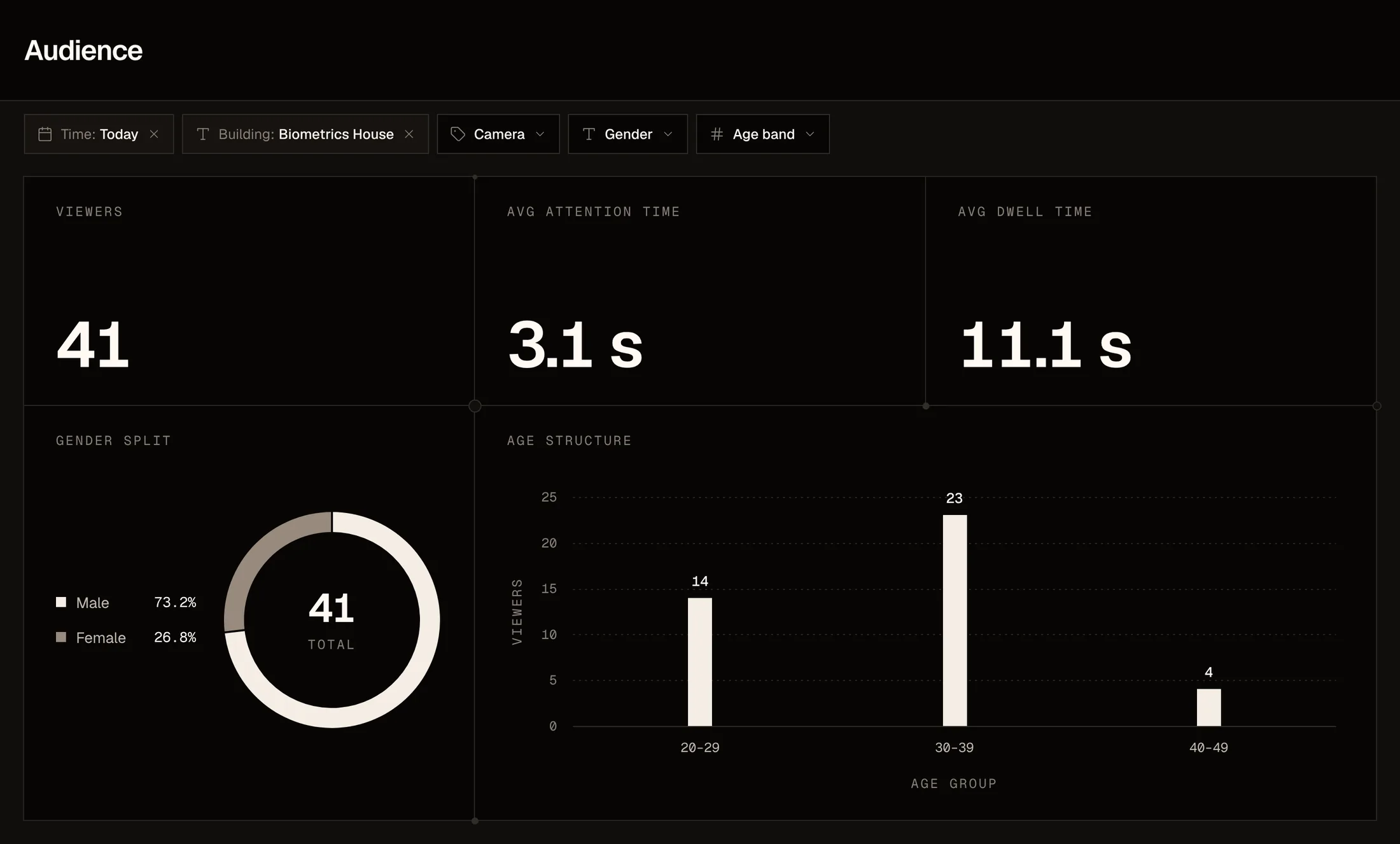
A camera watches the people in front of a placement — a screen, a shop window, a printed billboard, anything people look at — and counts the ones who turned to look at it, and for how long. Someone who walks past without turning their head is counted separately. What comes out is anonymous totals with timestamps, so a number belongs to whatever was up when it was earned.
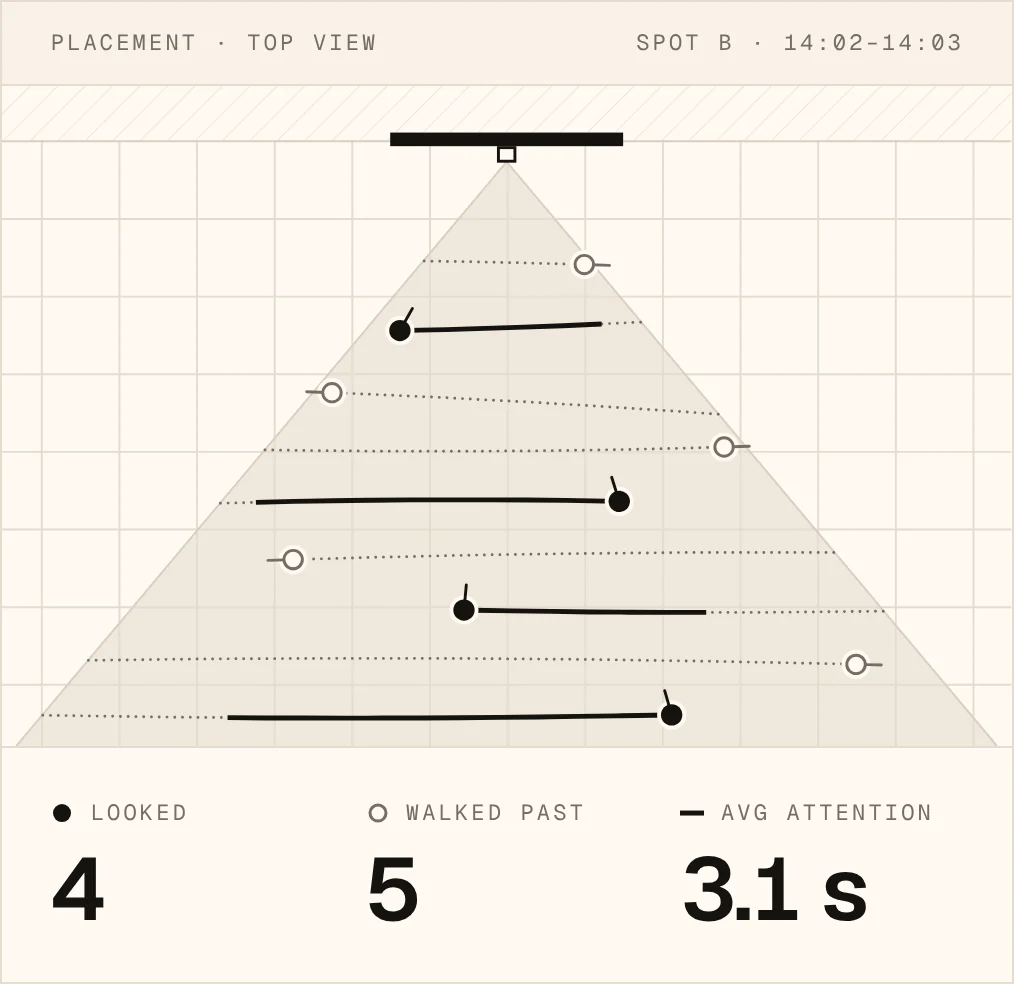
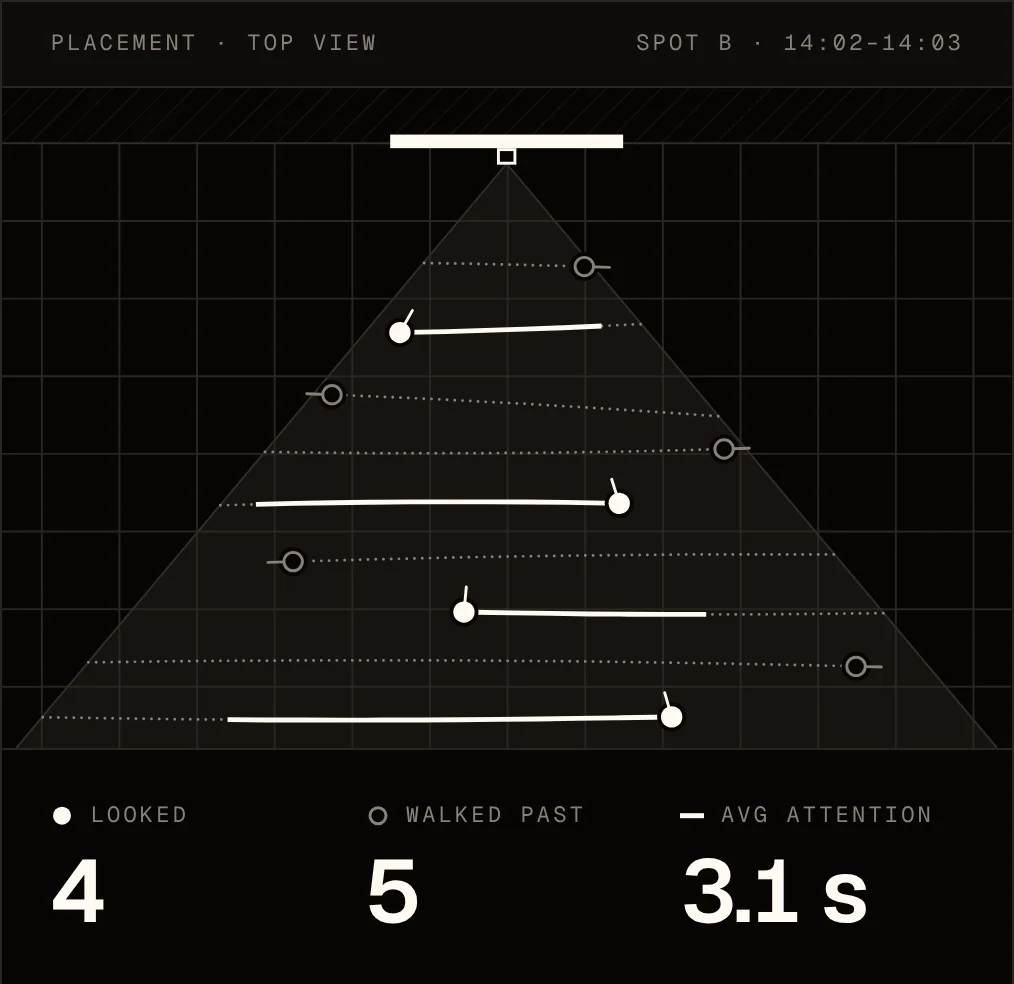
Walking past and looking are not the same number.
The algorithms run on the camera itself. They hold each face for as long as it stays in view, which gives dwell time, and read the orientation of the head — which is what separates a person who stopped and looked from one who crossed the whole frame without ever turning towards it.
The camera does not have to sit in any particular spot, as long as the faces in front of the placement are in its view. It is usually a pinhole — flexible to mount, and unobtrusive once it is.
- Dwell time
- how long a face was in front of the placement at all, someone walking straight past included.
- Attention time
- how much of that was spent facing it. Head orientation — not eye tracking, and nobody’s gaze is followed.
- Age group and gender
- estimated from the face, in bands. The total is a count; the band is an estimate.
- Works on
- A digital screen, a shop window, a printed billboard — the camera watches the people, not the surface.
Every figure has a time on it.
Totals arrive by interval, timestamped. Set them against a screen’s playlist and the audience belongs to a creative rather than to a site. For a window or a poster that changes less often, the same figures say which hours and which days earned the attention — and what moved the week you changed what was up.

It never works out who it is looking at.
- It never identifies anyone.
- No re-identification — not across visits, not across cameras. A second visit is a second count.
- No watchlist, and no face database to match against.
- No video recorded, and no photographs or face crops stored, anywhere.
- No biometric template stored, so there is nothing that could find someone again later.
- No emotion recognition.
- Nothing about an individual leaves the camera.
The technical questions are the good ones.
Tell us what the placement is, where a lens could sit and what you need the figures to prove. If your side has a works council or a data protection officer, bring them — the short version is that nothing about a person ever leaves the camera, and the long version is a three-page technical description we will send you.